How UEFA Decide on Champions League Final Venues
- Last Updated On
- Ben Green
Picking a Champions League final host sounds simple from the outside. UEFA needs one stadium, one city, one night where the biggest club game in the world can play out in front of a global TV audience.
In practice it is a years-long process involving competing bids, stadium inspections, hotel room counts, and, on at least one recent occasion, a snap decision taken because of a war. Below is how UEFA actually makes the call, which criteria matter most, and the full run of host venues from 1956 through to the three finals UEFA has already locked in for 2027, 2028 and 2029.
How UEFA Decide Champions League Final Venues: Key Takeaways
- Hosts are awarded by the UEFA Executive Committee, usually three to four years in advance, after national associations, clubs and stadium operators submit joint bids against a published set of criteria.
- Stadium requirements go well beyond capacity. UEFA's Category Four classification covers floodlighting, VIP space, media facilities and security, while hotel stock, airport capacity and transport links decide whether a city can actually host 70,000-plus visitors for a week.
- Politics can override everything else. UEFA stripped Saint Petersburg's Gazprom Arena of the 2022 final within days of Russia's invasion of Ukraine and moved it to Paris, and Istanbul lost the final twice to COVID-19 before finally hosting in 2023.
★ Browse Champions League Final Tickets ★
The Champions League Final Bidding Process: Who Actually Applies to UEFA
A Champions League final bid is never just a stadium putting its hand up. UEFA requires a joint submission from the national football association, the stadium operator and, in effect, the host city and government, since policing, transport and visa arrangements for a week-long "Champions Festival" fall on local authorities rather than UEFA itself.
UEFA's own events and stadium infrastructure teams inspect the shortlisted venues before making a recommendation. The final sign-off sits with the UEFA Executive Committee, the same body that approves the Champions League, Europa League and Conference League hosts in a single round of voting.
Bids are typically awarded three to four seasons out, though that timeline is not fixed. UEFA has reopened tenders at short notice when circumstances changed, most notably reopening the 2027 process in 2024 after an earlier round had left it unresolved.
Losing a bid rarely ends a city's interest. Istanbul, Budapest, Milan and Baku have all bid more than once for a final before either succeeding or dropping out, and a rejected bid in one cycle is frequently resubmitted, sometimes successfully, for the next available year.
What UEFA Actually Scores: Stadium Capacity, Category Four Status And Hospitality
Every Champions League fixture from the play-off round onward, the final included, has to be played at a venue holding UEFA's Category Four classification, formerly known as "Elite" status. The written regulation is less demanding than most fans assume: Category Four only requires a minimum of 8,000 seats, backup floodlighting that can reach broadcast standard within 15 minutes of a power cut, at least 100 VIP seats, roughly 60 media seats, and a press conference room holding 50 people.
In practice, no final has come close to that minimum capacity in decades. UEFA set out a preference for stadiums of around 70,000 seats or more for showpiece finals back in 2007, and that preference has effectively become policy.
Every final venue since 2010, bar the pandemic-hit years when attendance was restricted, has held at least 60,000 fans.
Beyond the venue itself, UEFA is scoring the surrounding city. Hotel room inventory for players, officials, sponsors and travelling fans, airport capacity to land a sudden spike of flights, public transport that can move tens of thousands of fans without gridlocking the city, and a credible security plan agreed with local police all factor into the final decision.
A stadium's track record with previous major events, whether that's a World Cup final, a European Championship, or an Olympic opening ceremony, strengthens a bid considerably, since UEFA is effectively betting on a city it already knows can cope.
When Politics Overrules The Bid: Russia, Ukraine And The 2022 Final's Move To Paris
The clearest example of how little a finished bid can mean came in February 2022. Saint Petersburg's Gazprom Arena had already been confirmed to host that year's final.
UEFA's Executive Committee held an emergency meeting on 25 February, days after Russia invaded Ukraine, and stripped the city of hosting rights entirely. The match kept its original date and kick-off time but switched continent within the stadium itself, moving to the Stade de France in Saint-Denis, where Real Madrid beat Liverpool 1-0.
Istanbul's experience shows the same principle at work on a smaller scale. The Atatürk Olympic Stadium was originally lined up to host the 2020 final, only for the match to move to Lisbon's Estádio da Luz because of COVID-19 travel restrictions.
The following year's final, also pencilled in for Istanbul, shifted again, this time to Porto's Estádio do Dragão for the same pandemic-related reasons. Istanbul finally got its final in 2023, the third time UEFA had tried to get a showpiece match into the city.
Host Rotation: Why The Champions League Final Rarely Repeats A Country Two Years Running
UEFA does not formally guarantee a geographic rotation the way some other sports governing bodies do, but the pattern across recent decades is unmistakable. England, Spain, Germany and Italy have hosted the overwhelming majority of finals between them, reflecting their stadium infrastructure and their clubs' dominance of the competition.
Yet UEFA has consistently used the final to showcase smaller or less obvious football nations too: Hungary (Budapest, 2026), Azerbaijan's bid for 2027, and one-off hosts like Greece and Austria earlier in the competition's history.
Wembley remains the single most-used venue in the competition's history, and it continues to put itself forward for new finals. London's bid for the 2029 final lost out to Barcelona's Camp Nou, a decision UEFA confirmed alongside Munich's award of the 2028 final in the same round of Executive Committee votes.
Wembley Stadium last hosted the Champions League final in 2024, when Real Madrid beat Borussia Dortmund.
Inside A Recent Bidding Battle: Budapest Beats Milan, Madrid Beats Baku
The clearest recent illustration of UEFA's decision-making came in the back-to-back bidding rounds for 2026 and 2027. Budapest's Puskás Aréna and Milan's San Siro were the two candidates for 2026.
UEFA picked Hungary's capital over Italy's, largely because of lingering uncertainty around San Siro's redevelopment plans and the ongoing dispute over whether AC Milan and Inter would keep playing there at all.
The 2027 process went a round further. An initial bidding window failed to produce a confirmed host, so UEFA reopened the tender in 2024.
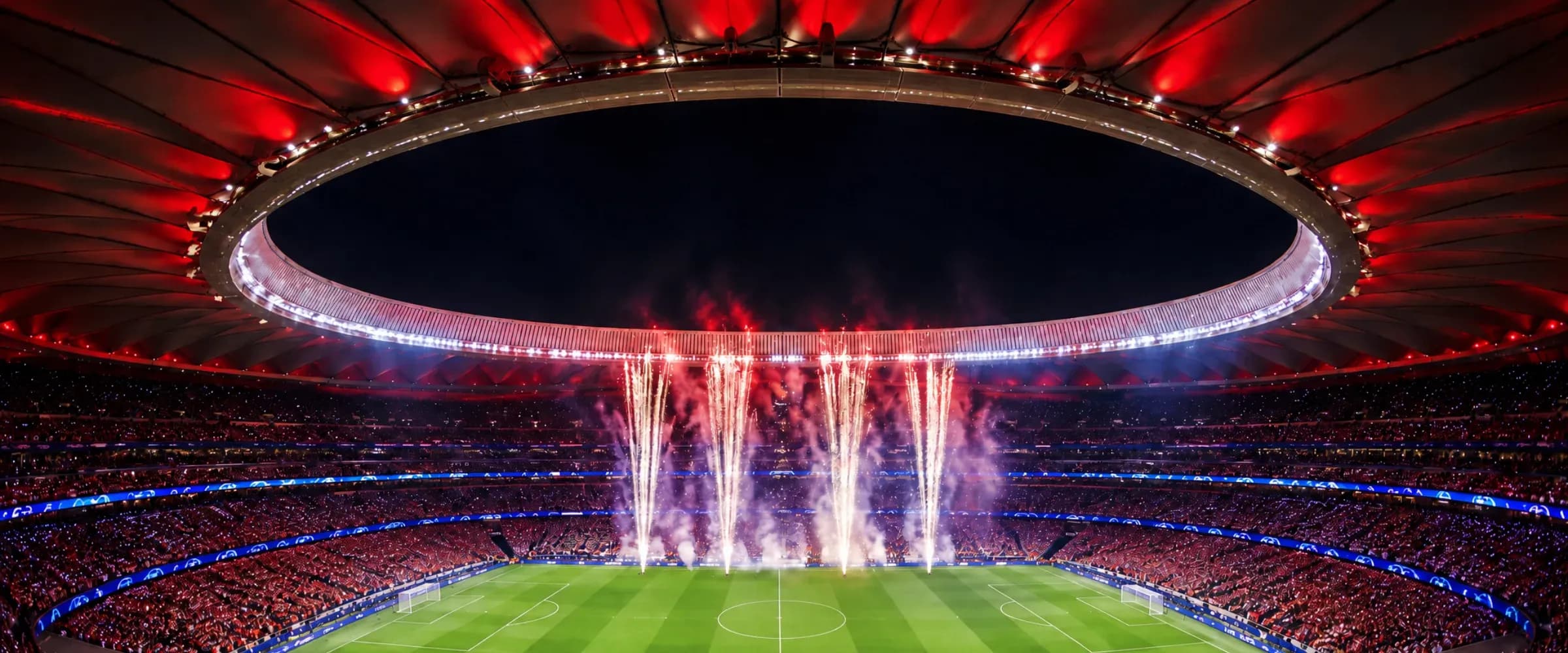
Azerbaijan put forward Baku's Olympic Stadium, while Spain backed Atlético Madrid's Metropolitano, now officially the Riyadh Air Metropolitano under its current sponsorship deal. Madrid's transport links, existing hosting experience and modern infrastructure won out, and the stadium is confirmed to host the final on 5 June 2027.
Browse Champions League Tickets →
Champions League Final Venues: Every Host From 1956 To Barcelona 2029
UEFA has already locked in the next three finals beyond this season, continuing the pattern of moving the showpiece around Europe's biggest footballing nations. The table below covers every final played since the competition launched in 1956, through to the three confirmed future hosts.
| Year | Stadium | Result |
|---|---|---|
| 2029 | Camp Nou, Barcelona | Confirmed host, fixture TBC |
| 2028 | Allianz Arena, Munich (staged as "Munich Football Arena" under UEFA's neutral naming rules) | Confirmed host, fixture TBC |
| 2027 | Riyadh Air Metropolitano, Madrid | Confirmed host, 5 June 2027, fixture TBC |
| 2026 | Puskás Aréna, Budapest | Paris Saint-Germain 1-1 Arsenal (PSG won 4-3 on penalties, after extra time) |
| 2025 | Allianz Arena, Munich | Paris Saint-Germain 5-0 Inter Milan |
| 2024 | Wembley Stadium | Real Madrid 2-0 Borussia Dortmund |
| 2023 | Atatürk Olympic Stadium, Istanbul | Manchester City 1-0 Inter Milan |
| 2022 | Stade de France, Saint-Denis | Real Madrid 1-0 Liverpool |
| 2021 | Estádio do Dragão, Porto | Chelsea 1-0 Manchester City |
| 2020 | Estádio da Luz, Lisbon | Bayern Munich 1-0 Paris Saint-Germain |
| 2019 | Wanda Metropolitano, Madrid | Liverpool 2-0 Tottenham Hotspur |
| 2018 | NSC Olimpiyskiy, Kyiv | Real Madrid 3-1 Liverpool |
| 2017 | Millennium Stadium, Cardiff | Real Madrid 4-1 Juventus |
| 2016 | San Siro, Milan | Real Madrid 1-1 Atletico Madrid (Real Madrid won 5-3 on penalties) |
| 2015 | Olympiastadion Berlin | Barcelona 3-1 Juventus |
| 2014 | Estadio da Luz, Lisbon | Real Madrid 4-1 Atletico Madrid |
| 2013 | Wembley Stadium | Bayern Munich 2-1 Borussia Dortmund |
| 2012 | Allianz Arena, Munich | Chelsea 1-1 Bayern Munich (Chelsea won 4-3 on penalties) |
| 2011 | Wembley Stadium | Barcelona 3-1 Manchester United |
| 2010 | Estadio Santiago Bernabeu, Madrid | Inter Milan 2-0 Bayern Munich |
| 2009 | Stadio Olimpico, Rome | Barcelona 2-0 Manchester United |
| 2008 | Luzhniki Stadium, Moscow | Manchester United 1-1 Chelsea (Manchester United won 6-5 on penalties) |
| 2007 | OAKA Stadium, Athens | AC Milan 2-1 Liverpool |
| 2006 | Stade de France, Saint-Denis | Barcelona 2-1 Arsenal |
| 2005 | Atatürk Olympic Stadium, Istanbul | Liverpool 3-3 AC Milan (Liverpool won 3-2 on penalties) |
| 2004 | Arena AufSchalke, Gelsenkirchen | Porto 3-0 Monaco |
| 2003 | Old Trafford, Manchester | AC Milan 0-0 Juventus (AC Milan won 3-2 on penalties) |
| 2002 | Hampden Park, Glasgow | Real Madrid 3-0 Valencia |
| 2001 | San Siro, Milan | Bayern Munich 1-1 Valencia (Bayern Munich won 5-4 on penalties) |
| 2000 | Stade de France, Saint-Denis | Real Madrid 3-0 Valencia |
| 1999 | Camp Nou, Barcelona | Manchester United 2-1 Bayern Munich |
| 1998 | Amsterdam ArenA | Real Madrid 1-0 Juventus |
| 1997 | Olympiastadion, Munich | Borussia Dortmund 3-1 Juventus |
| 1996 | Stadio Olimpico, Rome | Juventus 1-1 Ajax (Juventus won 4-2 on penalties) |
| 1995 | Ernst Happel Stadion, Vienna | Ajax 1-0 AC Milan |
| 1994 | OAKA Stadium, Athens | AC Milan 4-0 Barcelona |
| 1993 | Olympiastadion, Munich | Olympique Marseille 1-0 AC Milan |
| 1992 | Wembley Stadium | Barcelona 1-0 Sampdoria |
| 1991 | Stadio San Nicola, Bari | Red Star Belgrade 0-0 Olympique Marseille (Red Star won 5-3 on penalties) |
| 1990 | Prater Stadion, Vienna | AC Milan 1-0 SL Benfica |
| 1989 | Camp Nou, Barcelona | AC Milan 4-0 Steaua Bucharest |
| 1988 | Neckarstadion, Stuttgart | PSV Eindhoven 0-0 Benfica (PSV won 6-5 on penalties) |
| 1987 | Prater Stadion, Vienna | Porto 2-1 Bayern Munich |
| 1986 | Estadio Ramon Sanchez Pizjuan, Seville | Steaua Bucharest 0-0 Barcelona (Steaua won 2-0 on penalties) |
| 1985 | Heysel Stadium, Brussels | Juventus 1-0 Liverpool |
| 1984 | Stadio Olimpico, Rome | Liverpool 1-1 Roma (Liverpool won 4-2 on penalties) |
| 1983 | OAKA Stadium, Athens | Hamburg 1-0 Juventus |
| 1982 | De Kuip, Rotterdam | Aston Villa 1-0 Bayern Munich |
| 1981 | Parc des Princes, Paris | Liverpool 1-0 Real Madrid |
| 1980 | Estadio Santiago Bernabeu, Madrid | Nottingham Forest 1-0 Hamburg |
| 1979 | Olympiastadion, Munich | Nottingham Forest 1-0 Malmo |
| 1978 | Wembley Stadium | Liverpool 1-0 Club Brugge |
| 1977 | Stadio Olimpico, Rome | Liverpool 3-1 Borussia Monchengladbach |
| 1976 | Hampden Park, Glasgow | Bayern Munich 1-0 Saint-Etienne |
| 1975 | Parc des Princes, Paris | Bayern Munich 2-0 Leeds United |
| 1974 | Heysel Stadium, Brussels | Bayern Munich 1-1 Atletico Madrid (Bayern Munich won replay 4-0) |
| 1973 | Stadion Crvena Zvezda, Belgrade | Ajax 1-0 Juventus |
| 1972 | De Kuip, Rotterdam | Ajax 2-0 Inter Milan |
| 1971 | Wembley Stadium | Ajax 2-0 Panathinaikos |
| 1970 | San Siro, Milan | Feyenoord 2-1 Celtic (after extra time) |
| 1969 | Estadio Santiago Bernabeu, Madrid | AC Milan 4-1 Ajax |
| 1968 | Wembley Stadium | Manchester United 4-1 Benfica (after extra time) |
| 1967 | Estadio Nacional, Lisbon | Celtic 2-1 Inter Milan |
| 1966 | Heysel Stadium, Brussels | Real Madrid 2-1 Partizan |
| 1965 | San Siro, Milan | Inter Milan 1-0 Benfica |
| 1964 | Prater Stadion, Vienna | Inter Milan 3-1 Real Madrid |
| 1963 | Wembley Stadium | AC Milan 2-1 Benfica |
| 1962 | Olympisch Stadion, Amsterdam | Benfica 5-3 Real Madrid |
| 1961 | Wankdorfstadion, Bern | Benfica 3-2 Barcelona |
| 1960 | Hampden Park, Glasgow | Real Madrid 7-3 Eintracht Frankfurt |
| 1959 | Neckarstadion, Stuttgart | Real Madrid 2-0 Stade de Reims |
| 1958 | Heysel Stadium, Brussels | Real Madrid 3-2 AC Milan (after extra time) |
| 1957 | Estadio Santiago Bernabeu, Madrid | Real Madrid 2-0 Fiorentina |
| 1956 | Stade Velodrome, Paris | Real Madrid 4-3 Stade de Reims |
Venue and result data compiled from official UEFA and competition records as of November 2026. The 2027, 2028 and 2029 hosts are confirmed; the fixtures for those finals are not yet known.
Where To Buy Champions League Final Tickets
UEFA's own ballot is the official route in, and it is also the hardest to win. Fans register via UEFA.com and select from four or five price categories (CAT 4 through CAT 1, plus VIP hospitality).
Demand always vastly outstrips supply, regardless of which two teams eventually qualify or where the final is being played. The two finalist clubs also run a separate, smaller allocation for their own season ticket holders and loyalty members, which is a realistic option only for fans with a long-standing relationship with one of the clubs involved.
For almost everyone else, the resale market is the practical way to secure a seat once the finalists are known. Prices for the 2025 final between PSG and Inter Milan and the following year's Arsenal vs PSG decider in Budapest both showed how dramatically cost moves once genuine demand kicks in.
SeatPick compares listings from hundreds of vetted resale sellers in one place, which is the fastest way to see every option on the market rather than checking individual platforms one by one.
How UEFA Decide Champions League Final Venues: Frequently Asked Questions
How Does UEFA Choose The Champions League Final Venue?
The national football association, stadium operator and host city jointly submit a bid against UEFA's published criteria. UEFA's own inspection teams assess the venues, and the UEFA Executive Committee makes the final decision, typically three to four years before the match is played.
What Stadium Criteria Does UEFA Require For The Champions League Final?
Formally, a UEFA Category Four classification, which covers floodlighting, VIP and media facilities, and security standards. In practice, UEFA has preferred stadiums of roughly 70,000 seats or more for finals since 2007, alongside strong hotel, airport and transport capacity in the host city.
Why Was The 2022 Champions League Final Moved From Russia To Paris?
UEFA's Executive Committee stripped Saint Petersburg's Gazprom Arena of hosting rights on 25 February 2022, days after Russia's invasion of Ukraine. The match was relocated to the Stade de France in Paris on its original date.
Where Is The Champions League Final Being Played In 2027, 2028 And 2029?
The 2027 final is confirmed for the Riyadh Air Metropolitano in Madrid on 5 June 2027. Munich's Allianz Arena, staged as "Munich Football Arena" for the competition, hosts in 2028, and Barcelona's Camp Nou hosts in 2029 after beating Wembley's bid for that year.
Can A Club Play A Champions League Final In Its Own Stadium?
Yes, and it has happened before, though it is rare since UEFA generally selects neutral venues years ahead of knowing which teams will qualify. If you're following the equivalent process for UEFA's other European final, our guide to Europa League final venues and ticket prices covers the same bidding system applied to that competition.