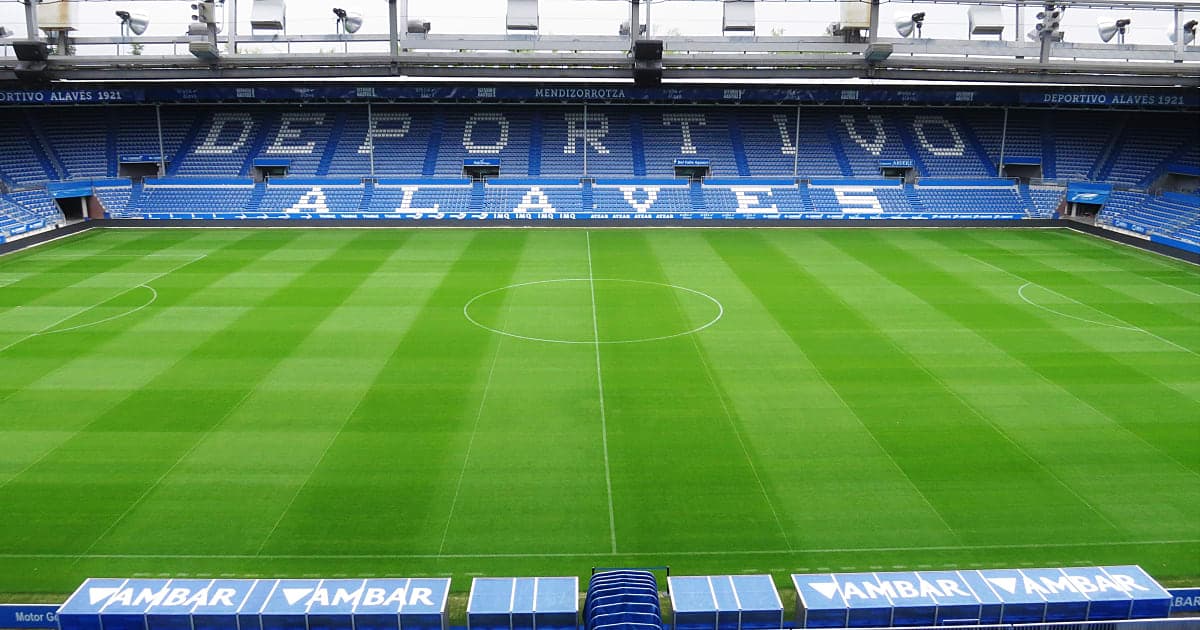
The Basque country is home to some of the most devoted football fans, something evident at the stands of Mendizorrotza, the home ground of Deportivo Alaves. This is a small club that, in its over a century of history, has enjoyed the support of Vitoria-Gasteiz residents. The fans have reflected the character of the land, always faithful and dedicated, chanting the team's songs during the seasons the club played in La Liga, but also during the relegation to lower competitions. The most shining moment in the club's resume was the UEFA Cup final in the 2000/01 season when Liverpool took away the opportunity for European glory in an epic match ending 4-5.
Nicknamed the Babazorros, which translates to bean eaters, is a badge of honour for some fans. While not surprisingly, other supporters prefer the alternative El Glorioso, meaning the glorious one. The club is considered one of the three top teams in the Basque region. That reputation creates a high demand for football tickets that supporters can overcome via SeatPick's network of sellers and find the best deal for upcoming football matches.
About Deportivo Alaves Football Tickets
The heritage of Deportivo Alaves traces its roots to 1920 with the establishment of Sports Friends in the Alava province of Spain. The football club changed its name to Deportivo Alaves in 1921 and accepted the new date as its founding moment. The initial years were promising - in the 1929-30 season, the team was the first in the competition's history to get promoted to La Liga, with a three-year stint.
In the next two decades, the team bounced between lower divisions, with a comeback to the top tier in 1954–55, where it competed for another season, followed by a repeat of the old cycle. The next reemergence in La Liga occurred in the 1970–71 season but turned out to be a short-lived one-season experience. The team was absent from the top tier until the 1998–99 season. It started a five-year membership in the elite Spanish competition that concluded in the 2003–04 season when the team got relegated to the Second Division. During those five seasons, the club qualified for the UEFA Cup on two occasions and had some of its best results.
The reinvigorated Basque club made a new offensive in 2016–17 when it got promoted to La Liga, where it participated from 2017-18 until the 2021–22 season. After relegation, Alaves needed just one season to secure promotion back to La Liga. Fans can use SeatPick to see them in action against Spain's best clubs.
Top Rivalry
Deportivo Alaves is entangled in the Basque derby with two other football clubs, Real Sociedad and Athletic Bilbao. There have been several thrilling matches, such as the duel in 2008, when Sociedad and Alaves were at opposite ends of the Second Division table. Alaves tried to escape the looming relegation while Real Sociedad strived to score extra points that would have promoted them to the top tier. Deportivo turned the tide in the last minutes with two late goals for a final score of 3-2, a crucial victory that helped the team survive in the Second Division by one point.
Top Managers
Popular coaches that served as managers of Deportivo Alaves are Ferenc Puskas, Abelardo Fernandez, Koldo Aguirre and Ignacio Eizaguirre.
Famous Footballers that Played for the Babazorros
The roster of Deportivo Alaves never was loaded with tier one level talent, but several reliable and productive players have taken the field at Mendizorrotza Stadium. Some local fan favourites are:
- Javi Moreno
- Cosmin Contra
- David Aganzo
- Manu Garcia
- Ibai Gomez
- Fabricio Coloccini
Mendizorrotza - Vitoria-Gasteiz, Spain
Stadium Name: Mendizorrotza
Capacity: 19,840
Address: Paseo de Cervantes,s/n, 01007
Description: Mendizorrotza is the third oldest football stadium in Spain still in use. The venue opened in 1924 but was renovated, with a current capacity of 19,840 seats. The venue hosts live events like concerts.
Best Way to Travel
Situated in the southwest of Vitoria-Gasteiz, the stadium is about a mile from the train station and the city centre. It's 15 minutes from both locations to the stadium.
By Train
Trains connect Vitoria-Gasteiz with almost every large metropolis in Spain.
By Bus
Local bus lines 4, 6, A, and B transit to the stadium.